





Quite recently, in late summer 2026, the international agency S&P Global Ratings affirmed India’s sovereign credit rating at BBB with a stable outlook. The agency expects the country’s real GDP to grow by about 6.6% in 2026 and notes the resilience of economic policy and a high level of infrastructure investment. At the same time, further upgrades are constrained by weak fiscal indicators, a significant debt burden, and relatively low GDP per capita. (Source: S&P Global Ratings, 27.08.2026).
S&P’s assessment is currently somewhat higher than the positions of other major rating agencies. Fitch Ratings affirmed India’s rating at BBB- with a stable outlook on August 11; Moody's maintains a Baa3 rating with a stable outlook. The main constraint remains the state of public finances: according to IMF estimates, India’s general government debt in FY2026 is about 83.4% of GDP, and the overall budget deficit is around 7.4% of GDP. At the same time, India’s economic growth rates remain significantly above the averages for countries in the corresponding rating category. (Source: Fitch Ratings, 11.08.2026; Moody's Ratings, 21.04.2026; IMF, Fiscal Monitor, April 2026).
The assessments of the leading rating agencies, despite certain differences, generally confirm India’s investment attractiveness and high economic potential, while at the same time pointing to persistent risks in public finances. For a more complete assessment of the country’s debt position, let us supplement this analysis with market indicators. Figure 1 shows the yield curve of Indian government bonds by maturity.
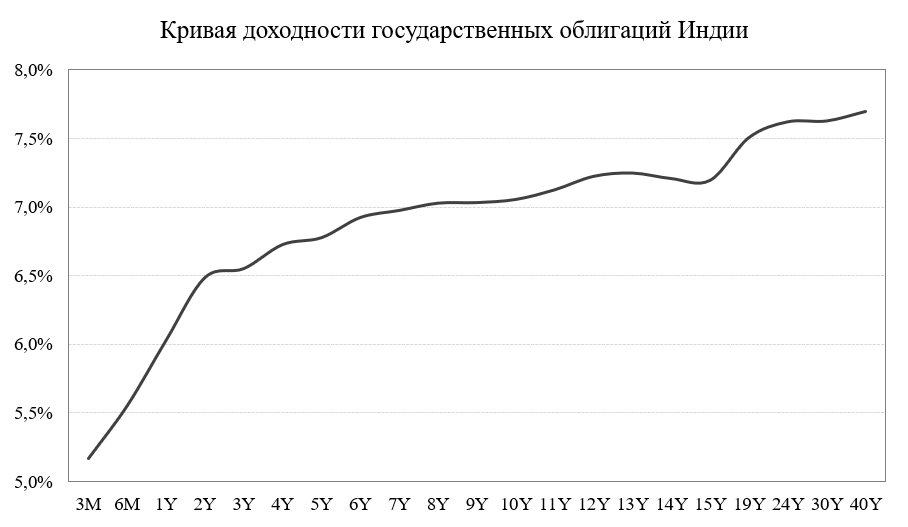
As can be seen in Figure 1, the yield curve has a normal upward shape (as of September 16, 2026, the yield on 1-year Indian government bonds was 6.031%, 5-year—6.777%, 10-year—7.055%, 15-year—7.194%, and 30-year—7.626%). The upward shape of the yield curve indicates the presence of an additional premium for long-term interest rate and inflation risks. At the same time, the relatively high yields on long-dated issues may support investor interest in Indian sovereign debt, especially against the backdrop of sustained economic growth and the preservation of the investment-grade credit rating.
The maintenance of the BBB rating highlights the gap between the strong momentum of the Indian economy and the condition of public finances. Growth rates above 6% support debt sustainability and investor interest; however, the current debt burden leaves limited fiscal room for budgetary stimulus in the event of new external shocks. Therefore, further upgrades of India’s ratings will likely depend to a lesser extent on the economy’s ability to grow rapidly and more on whether the government can use this growth to consistently reduce the deficit and public debt.
Overall, India’s credit rating is stable and, as the state addresses its fiscal challenges, has potential for improvement—thereby supporting the country’s sustainable development, which is especially important given India’s role as one of the largest BRICS participants.
Author: Doctor of Economics, Professor at the Department of World Economy and World Finance, Financial University under the Government of the Russian Federation Rinas Vasimovich Kashbraziev.

