





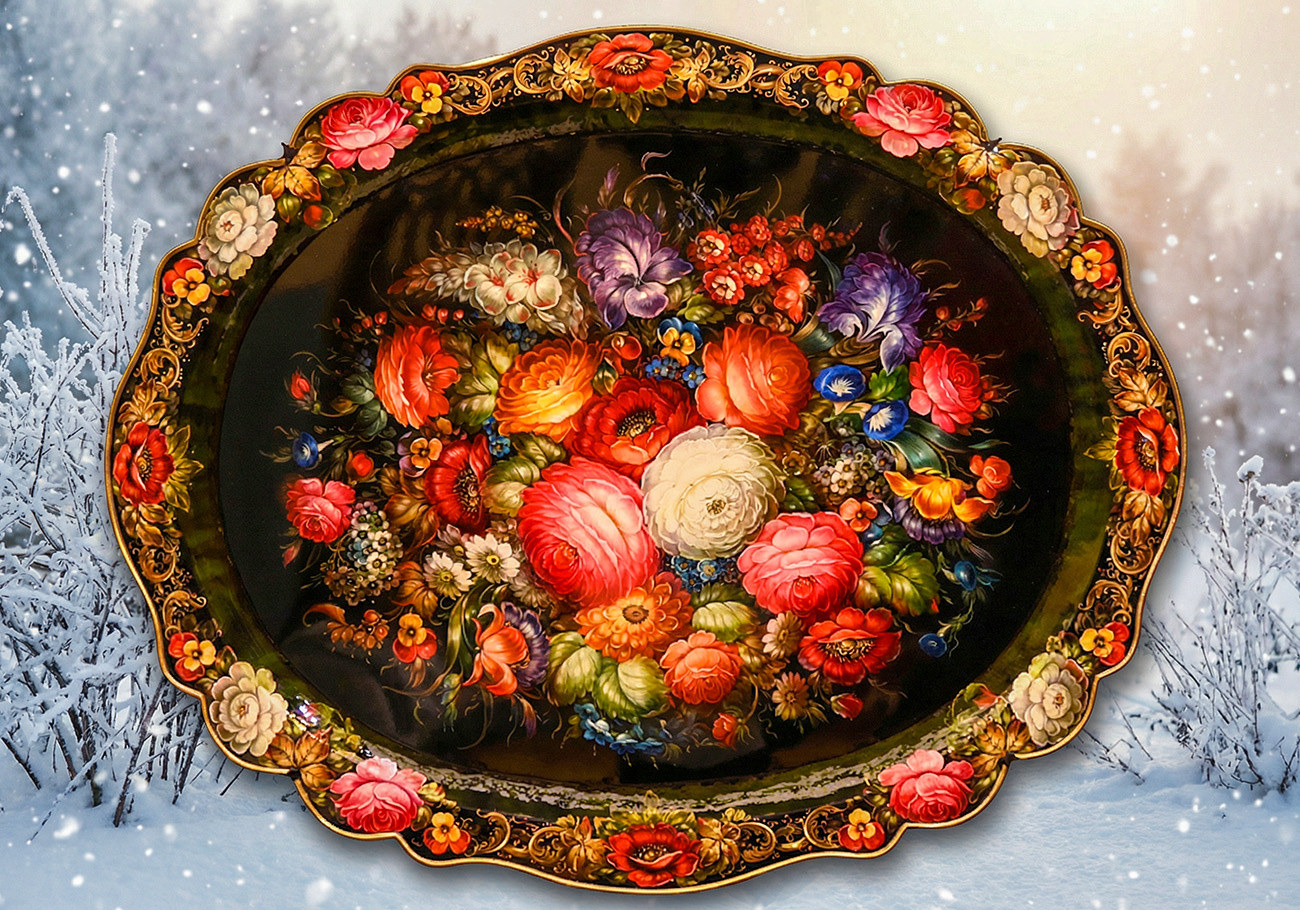
The exhibition dedicated to the unique Zhostovo craft continues at the Tsaritsyno Museum-Reserve. It is titled «Provocatively Beautiful». And it truly is—bright, colorful, and unusual, especially against the backdrop of the surrounding snow abundance. General Director of the Zhostovo Decorative Painting Factory Andrey Klimachev spoke about the distinctive features of the anniversary vernissage: «Our exhibition turned out to be not entirely ordinary. The emphasis is on experiments. And some of them are very daring, very bold. But believe me, those who started this craft 200 years ago also began with experiments. We wouldn't have seen metal trays. We wouldn't have seen still lifes, landscapes, and other paintings on them. Our exhibition is the result of many years of work and an opportunity to show a wide audience how Zhostovo painting lives, develops, and inspires. We are proud that in this anniversary year, archival materials, rare samples, as well as new author's collections created by our masters—both in traditional techniques and within bold creative experiments—are on display,» emphasized General Director of the Zhostovo Decorative Painting Factory Andrey Klimachev.
The official starting point of the unique craft is considered 1825, when the Vishnyakov brothers opened a workshop in Zhostovo for the production of lacquered metal trays, bread baskets, trays, caskets, and other decorative items. Since then, Zhostovo has come a long way from a handicraft trade to a symbol of Russian decorative tradition, preserving a unique art school and high quality of painting.
Today, the Zhostovo Factory is a full-cycle enterprise included in the Registry of Intangible Cultural Heritage of the Peoples of Russia. Here, artists and masters from dynasties work, where knowledge is passed down from generation to generation. The factory's products are kept in the Hermitage, the Russian Museum, the Tretyakov Gallery, and private collections around the world.
In the anniversary book prepared by the museum and the factory, the history of lacquer painting from the 19th century to the present is presented with rare archival photographs, reproductions of iconic works, and articles by art historians.
Zhostovo masters have developed their own unique style: bright, cheerful colors, the skillful "free stroke" technique, a combination of realistic details with decorative elements, unique designs—bouquets, landscapes, and fairy-tale motifs.
The anniversary exhibition explains the tray-making process, which consists of several stages. The first stage is forging or stamping. The blacksmith hammers out the tray, creating its shape; stamped trays are made on a special machine. After that, the puttyer primes it, now most often applying enamel with a spray gun. Then the master painter covers the tray with painting. The final stage is lacquering and drying.

Painting five to ten trays daily, the masters have achieved a high level of technique mastery, developing techniques such as "quick writing." The initial stage of work involves creating the overall design and composition. Then, using transparent glazing paints, shadows and main color solutions are gradually formed, layer by layer. Next, dense paints are used to work out details and refine forms. The painting is completed by applying highlights and fine outlining of plant motifs' contours.

The master, holding the tray on their knees and rotating it, refines the painting, adding individual strokes and creating circular patterns from petals, leaves, and spikelets. A soft squirrel brush is used for the work. Paints are generously mixed with linseed oil, ensuring smoothness and resilience of the stroke. The artist masterfully "sculpts" flowers, giving them volume with energetic brush movements. The apparent simplicity of the painting conceals a long and meticulous process of searching for the perfect bouquet, color palette, and pattern.
At the «Zhostovo. Provocatively Beautiful» exhibition, you can see mid-19th-century trays and avant-garde experiments from the 1920s-30s—products from the toy workshop of the Zhostovo Factory such as painted spatulas, scoops, buckets, and watering cans, as well as souvenirs issued for the 1949 Pushkin anniversary or the 1980 Olympics. In a separate display case are the results of collaborations between the Zhostovo Factory and contemporary Russian designers (for example, with the Radical Chic brand). The exhibition curators paid special attention to the authors: the exposition includes works by Mikhail Lebedev, the chief artist of the Zhostovo Factory, and another twenty masters shaping the modern face of the craft. More than forty items in the exposition are from the «ROSIZO» collection, another ideological partner of the exhibition.

