





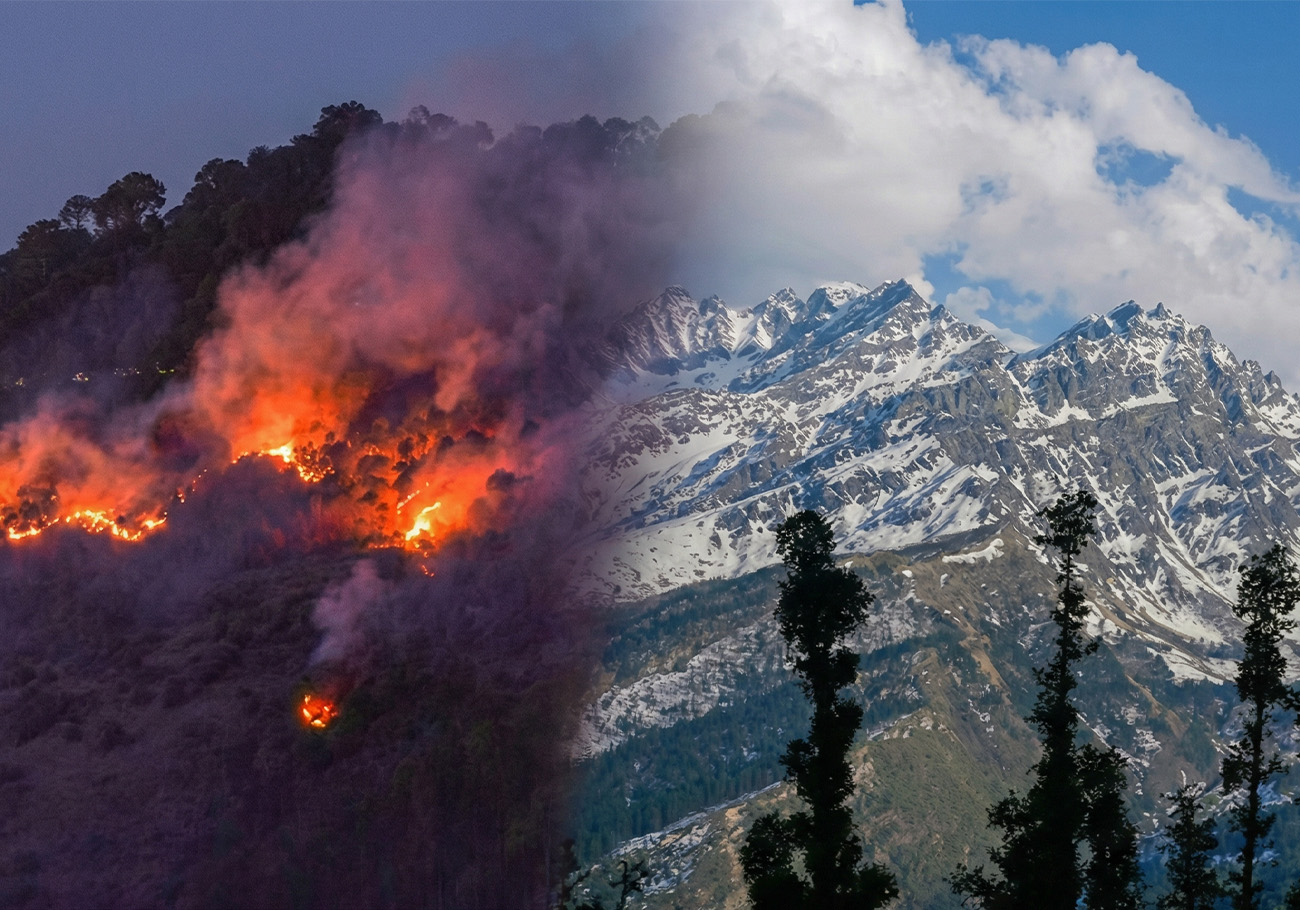
Indians traditionally anticipate flooded streets by July, snow-covered peaks in December and January, and forest fire headlines amid summer's scorching heat. Yet over the past few years, this seasonal rhythm has disrupted.
This winter, woodlands in Uttarakhand, Himachal Pradesh, and Jammu & Kashmir have ignited with unprecedented ferocity and frequency. Experts now view this not as an isolated event, but as a signal of broader ecological shifts.
India Today’s examination of satellite-based active fire detections highlights a dramatic increase in winter wildfires throughout Himalayan forests this season. From December 1 to January 20, fire incidents have jumped by 6,092 compared to the 2024–25 period. Specialists link this to an exceptionally arid winter, with scant rain and snow across the region.
Employing a tailored detection algorithm on Sentinel satellite images, India Today’s Open Source Intelligence (OSINT) team scrutinized forested areas in Himachal Pradesh’s Kullu Valley. The resulting images expose two clear patterns: fire severity has escalated in identical forest zones this year, while winter snow coverage has noticeably diminished.
Kashmir’s woodlands have also faced a severe, snow-poor winter. Blaze detections span the Valley and Pir Panjal range—from Uri and Bandipora to Nishat and Poonch. Without soil moisture, grasses and leaf litter turn highly combustible.
The widespread absence of snow in the Himalayas’ upper elevations this winter echoes a six-year trend in the region. India Today’s multi-year satellite analysis shows persistent drops in winter snow cover over the western Himalayas, including deficits in Uttarakhand’s highland basins, Himachal’s Kullu Valley, and Jammu & Kashmir’s Pir Panjal and Kishtwar ranges.
A Kumaon University study, drawing on satellite records from 1990 to 2022, revealed the average snowline in Uttarakhand’s Gori Ganga basin has risen by roughly 520m—from about 4,665m to 5,185m—at a rate exceeding 16m annually.
A fresh NASA analysis of Landsat imagery documented unusually elevated winter snowlines in the Mount Everest area, where snow pulled back upslope by nearly 490 feet over two months in the 2024-25 winter. Researchers note this points to snow increasingly failing to build up at lower altitudes, even in peak winter.
India Meteorological Department records indicate a steep drop in winter precipitation. Uttarakhand saw three to four feet of snow in 2021, shrinking to one to two feet in 2022. From 2023 to 2025, it dwindled to three inches down to one inch, and in 2026, it has been virtually absent so far.
Experts caution that insufficient snow may tip Uttarakhand’s glacier mass balance into negative territory, with ice loss outpacing winter gains.
Manish Mehta, glaciologist at the Wadia Institute of Himalayan Geology, noted that while Kashmir and Ladakh saw some snow this winter, Uttarakhand endured an extended dry period.
“This heightens the chances of negative glacier mass balance,” he explained. Less snow combined with warmer temperatures speeds up ice melt and can enlarge existing glacial lakes.
The proliferation of supraglacial lakes—pools forming atop glaciers—could rise further, raising enduring environmental and hazard risks.
