





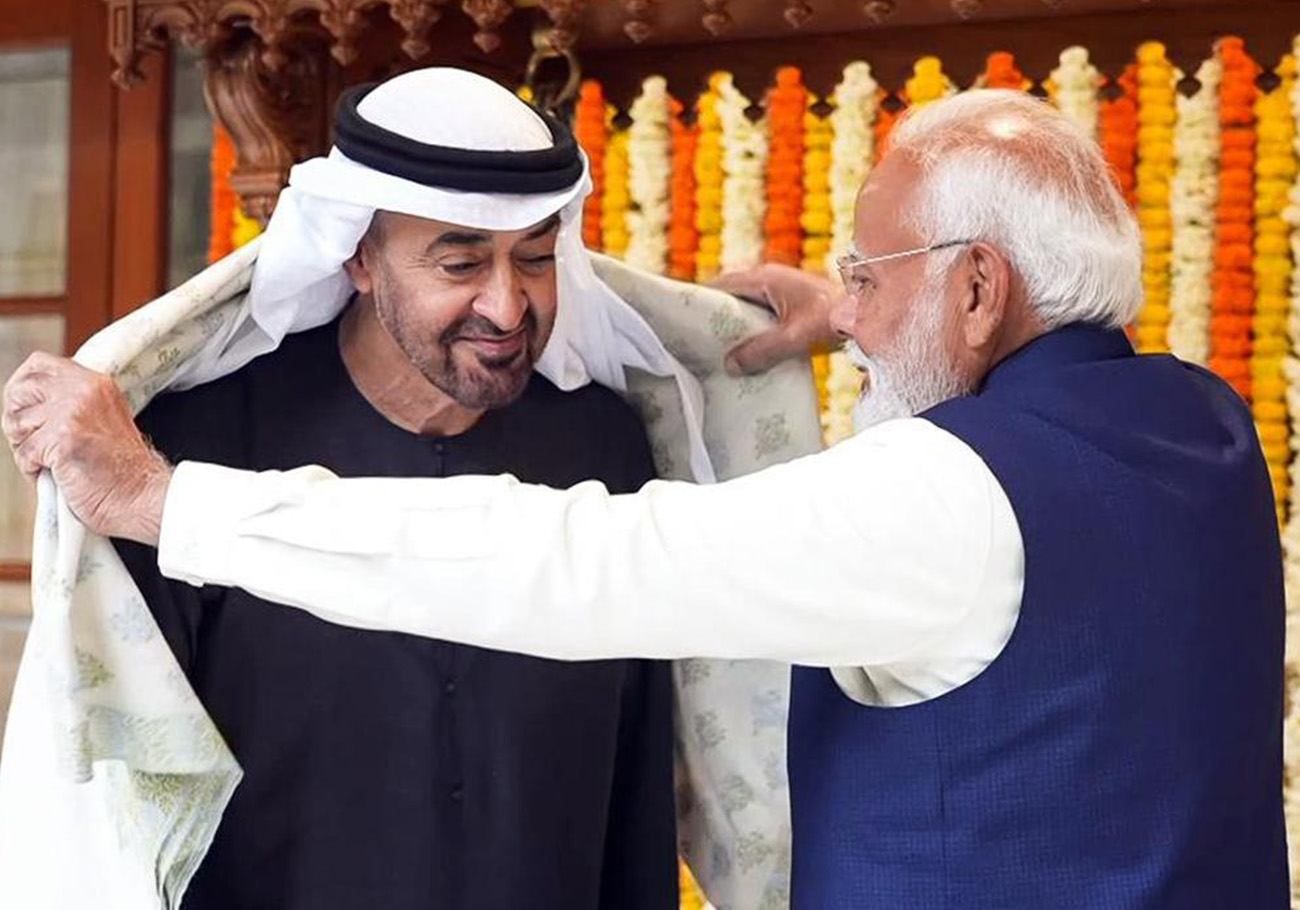
Amid rising military strains in the Gulf, India and the United Arab Emirates signed a 'Letter of Intent for a bilateral Strategic Defence Partnership' on Monday (January 19, 2026).
The agreement was finalized during a three-hour visit by UAE President Sheikh Mohamed bin Zayed Al Nahyan, where leaders pledged to double bilateral trade to $200 billion by 2032.
Prime Minister Narendra Modi welcomed the UAE leader at Palam Airport. Their talks covered topics like the Gaza situation—where President Donald Trump’s peace proposal faces upcoming tests—along with protests in Iran.
In a post-visit briefing, Foreign Secretary Vikram Misri revealed discussions on Yemen, where tensions have strained Saudi Arabia-UAE ties.
Addressing concerns that the India-UAE defense pact might pull India into Gulf conflicts, Misri clarified that the Letter of Intent targets "a framework agreement for Strategic Defence Partnership."
He described it as "a natural progression from our existing substantial defense ties, rather than a reaction to regional events or plans for hypothetical involvement," Misri added.
This defense pact emerges as the Gulf grapples with fallout from U.S.-Israel-Iran clashes, fueled by Tehran's suppression of protests calling for the Islamic Republic's downfall.
Meanwhile, Pakistan's military has ramped up support for Saudi defense in the Arabian Peninsula, particularly Yemen, following a mutual defense pact signed on September 17, 2025. This Saudi-Pakistan alliance has heightened pressures on the UAE, once Saudi Arabia's Yemen partner.
As major energy providers to India and hosts to millions of Indian expatriates, both Saudi Arabia and the UAE hold critical importance. India has long adopted a prudent stance in Gulf disputes to protect its interests.
Misri emphasized India's expanding defense ties not only with the UAE but also "several other regional nations." Officials informed The Hindu that, despite Saudi-UAE frictions, New Delhi anticipates de-escalation soon. They also mentioned a phone call between Pakistani Foreign Minister Ishaq Dar and Saudi Foreign Minister Al Farhan coinciding with the UAE president's arrival in New Delhi.
The visit followed a U.S. invitation for Modi to join the ‘Board of Peace for Gaza,’ including Gulf Arab leaders. Misri avoided details but confirmed Gaza talks between Sheikh Mohamed and Modi, plus enthusiasm for enhanced civil nuclear cooperation.
The sides inked an energy pact between HPCL (Hindustan Petroleum Company Ltd) and ADNOC (Abu Dhabi National Oil Company Gas), enabling HPCL to buy 0.5 MMPTA of LNG from ADNOC over 10 years from 2028. They also explored 'digital embassies' to protect 'sovereign data.'
Another Letter of Intent linked India's National Space Promotion and Authorisation Centre with the UAE Space Agency to boost the UAE's space sector. A joint statement post-visit stated: “This initiative aims to produce an integrated space ecosystem with end-to-end infrastructure and a strong industrial base. It aims to enable India–UAE joint missions, expand global commercial services, create high-skilled employment and start-ups and strengthen bilateral investment through sustainable business models.”
