





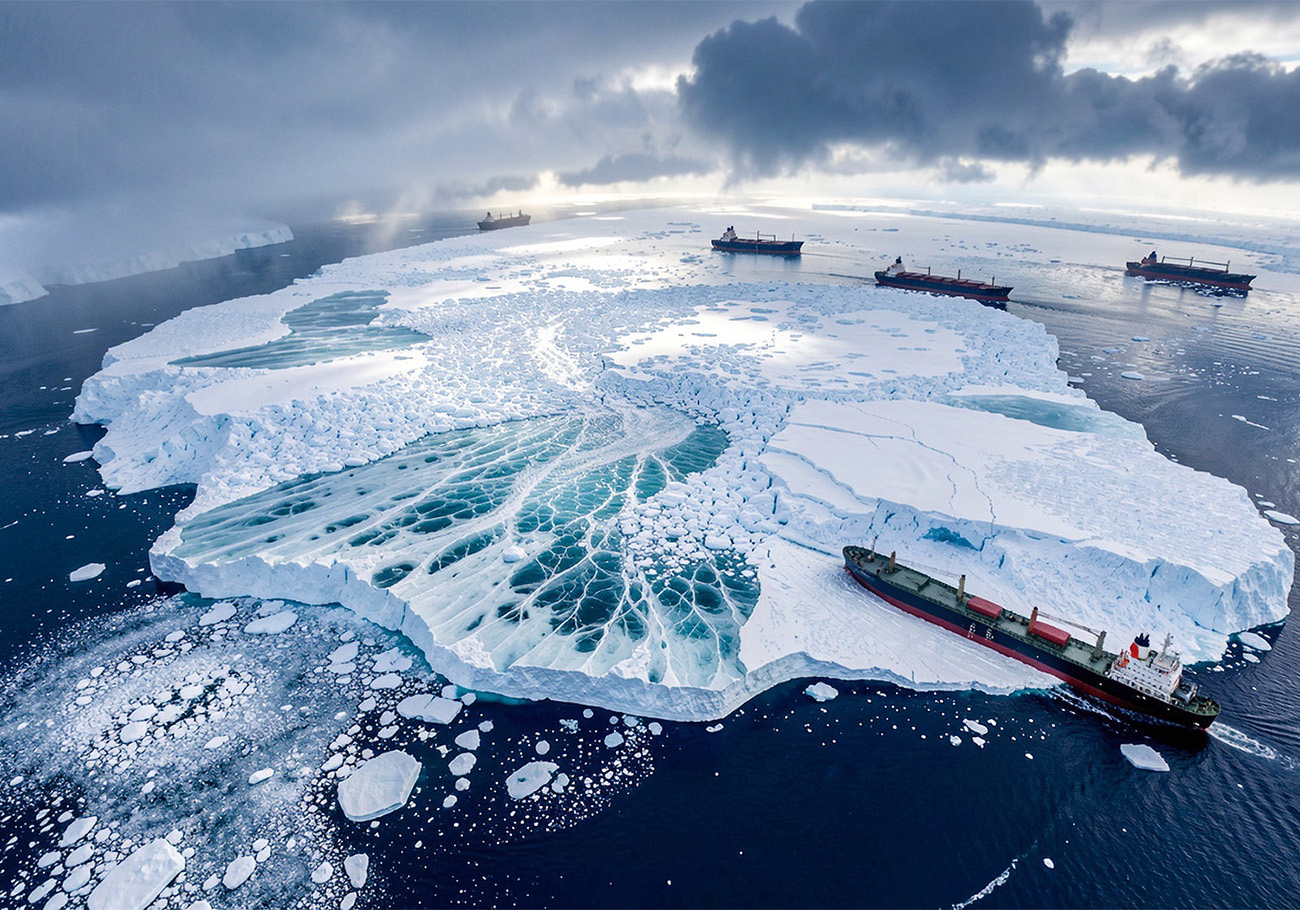
The high interest in the Arctic sharply increased in 2009 following the statement by the U.S. Geological Survey that the Arctic holds 13% of the world's undiscovered oil reserves and 30% of the world's natural gas reserves. Over the last 10 years, due to global climate warming, interest in the Arctic has risen again: according to data from the U.S. National Oceanic and Atmospheric Administration, the period from Oct. 2024 to Sept. 2025 became the warmest in the Arctic in the last 125 years, leading to ice melt, with its area last year reaching the minimum for such northern latitudes. This will allow for expanded shipping and the development of alternative transport-logistics corridors.
Currently, around 60 countries have expressed ambitions to develop the Arctic, with particular interest shown by such major world powers as Russia, the United States, and China.
The Russian Federation controls 1/3 of the Arctic's economic zone—the largest share compared to the United States, Denmark (via Greenland), Canada, and Norway. The Arctic zone provides Russia with over 80% of its combustible natural gas production (including gas condensate) and 17% of its oil. Russia is actively developing maritime transport corridors by expanding its fleet of next-generation nuclear icebreakers capable of breaking through ice more than 4 meters thick. This will enable Russia, despite the harsh climate and year-round Arctic weather conditions, to transport cargo via the Northern Sea Route, which is the shortest route from Europe to Asia in the world.
In addition, according to a decision by President V.V. Putin, the Russian Federation will develop the Trans-Arctic Transport Corridor, integrating maritime, rail, and road transport, as well as the potential of such navigable rivers as the Yenisei, Ob, and Lena. This will allow for infrastructure development in the Arctic and the Far East, counter sanctions at sea and in foreign economic relations, and more strongly integrate Russia's foreign trade with China within the "One Belt, One Road" initiative.
The United States became an Arctic power after purchasing Alaska in 1867, which is its largest state. The U.S. seeks to ensure national security, environmental protection, sustainable development, and cooperation with other Arctic countries through the Arctic. In recent times, there have also been intensified attempts to buy Greenland from Denmark. This proposal has objective geopolitical interests. Greenland is the world's largest island, with 80% of its area covered by the Greenland Ice Sheet, which contains vast reserves of frozen fresh water. Moreover, Greenland is located east of the Arctic Archipelago, and the melting of its ice due to climate warming, according to forecasts, could open new sea routes. This will allow the U.S. to further strengthen its influence in the Arctic amid intensifying competition with Russia and China.
China is highly interested in studying and investing in Arctic projects. The PRC has demonstrated growing ambitions by increasing investments in the Arctic, conducting research on military applications, and expanding its icebreaker fleet. China has made significant investments in Russian oil and LNG extraction projects (for example, "Yamal LNG" and "Arctic LNG-2"), and is also ramping up and developing cargo shipments via the Northern Sea Route, which in the 14th Five-Year Plan is designated as part of its Polar Silk Road. Since 2023, it has been considered in the context of integration into the "One Belt, One Road" initiative.
Thus, the changing role of the Arctic Archipelago and the growth of economic and other activities in this northern region will become one of the drivers of heightened competition between the three largest world powers in the near future!
Author: Candidate of Economic Sciences, Associate Professor of the Department of International Business at the Financial University under the Government of the Russian Federation, Victoria Viktorovna Zabolotskaya
